Синхронизация частоты и сбор сигнала
When using an acoustic camera, its PRPD detection frequency must first be set to match that of the equipment under test.
The equipment being tested is typically in operation within the power grid, and its fundamental frequencies are predominantly 60 Hz, 50 Hz, or 16.7 Hz (railway systems).
Акустическая камера обнаруживает пространственное распределение интенсивности ультразвука и строит график сигнала интенсивности звука во времени и частоте. Для оценки центральной фазы используются такие методы, как круговое среднее, распределение фон Мизеса и фазовые гистограммы. Между тем, шаблон PRPD строится с использованием оценки максимального правдоподобия для получения вероятностной модели распределения энергии, дающей максимальное значение логарифмического правдоподобия, которое можно использовать для последующей классификации или определения порога. Alignment
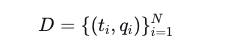
Предположим, был собран набор импульсов частичного разряда:
где:
На практике логарифм равен принято, чтобы избежать числового опустошения:
- ti: occurrence time of the -th pulse;
- qi: amplitude, apparent charge, or energy of the -th pulse;
- N: total number of pulses.
If the power frequency is (e.g., 50 Hz), the phase corresponding to each pulse can be written as:

The key unknown quantity here Δϕ is , i.e., the phase offset.
Consider a certain class of PRPD patterns as a probability distribution P(q,ϕ), , which represents the probability of a PD pulse occurring near phase ϕ and amplitude q. Given a specific phase offset Δϕ , the joint probability of all observed pulses is:

Оценка максимального правдоподобия ищет , которая максимизирует это логарифмическое правдоподобие:

Интуитивный Понимание

Шаблон PRPD постоянно циклически сдвигается вдоль фазовой оси. Угол сдвига, при котором импульсы тока лучше всего соответствуют эталонному распределению, принимается за оптимальное выравнивание фаз. Mixture
Разделение шума и чистая энергия Map
Объединив полевые данные с двумерной вероятностной гистограммой PRPD, можно получить стандартную карту распределения энергии, эффективно отфильтровывающую импульсный шум и обеспечивающую чистую вероятность распределения для измерения. point:
При дальнейшей обработке сигнала вводится байесовский метод оценки с использованием априорной информации для уменьшения систематической ошибки. Таким образом, алгоритм распознавания PRPD становится проблемой оценки вероятности во время измерения. data.
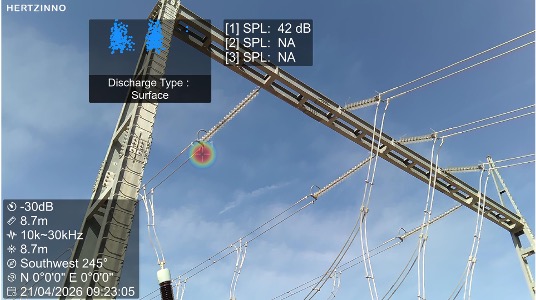
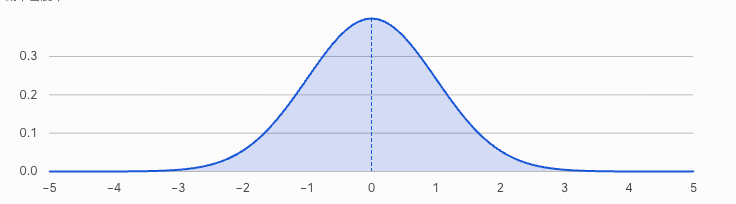
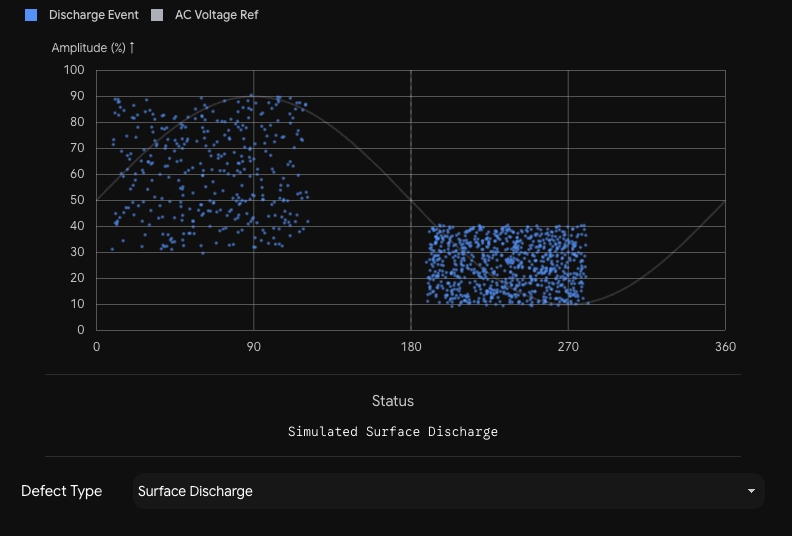
Common types of partial discharge include positive corona, negative corona, surface discharge, and floating discharge. Their discharge characteristics are well defined and typically concentrated around two phase regions, conforming to the von Mises distribution—that is, their discharge models follow a normal distribution on a circular variable.
Hence, the phase distribution can be expressed as:

Почему положительная и отрицательная корона не может быть разделенаd
Следует отметить, что, хотя положительную и отрицательную корону можно физически различить, акустическая камера не имеет опорной полярности напряжения и не может определить абсолютное пересечение нуля напряжения. Поэтому в практическом алгоритме распознавания положительная и отрицательная короны объединены в один класс «коронный разряд». Именно поэтому акустическая камера не может отличить отрицательную и положительную корону. Тем не менее, даже при таком слиянии акустическая камера по-прежнему может обеспечивать результаты с высокой достоверностью для общего обнаружения разрядов коронного типа. «Неопределенное» состояние

where:
- P(PD): the true PD distribution;
- Pnoise: the noise distribution;
- ϵ: the noise proportion.
Bayesian Estimation and Defect Classification
Prior Distribution
P(μ)
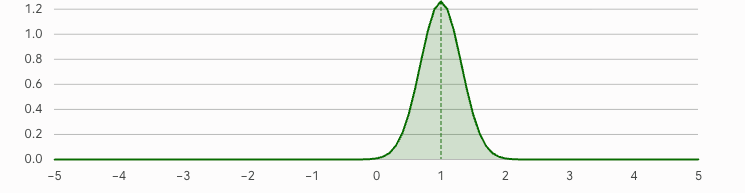
Самоконтролируемое обучение для восстановления фазы
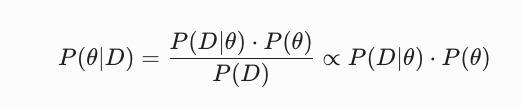
Bayesian estimation is a statistical inference method. Its core concept is not to find a single fixed parameter value, but to treat the parameter to be estimated as a random variable, using a probability distribution to describe the knowledge about that parameter.
На этапе обучения применяется стратегия самоконтролируемого обучения для автоматического построения крупномасштабных выборок: искусственные случайные циклические сдвиги (например, , , ) применяются к шаблонам PRPD, и перед моделью стоит задача спрогнозировать это смещение. Это обеспечивает обилие обучающих данных без маркировки вручную и позволяет модели научиться восстанавливать истинную фазу по возмущениям. сеть пространственного преобразователя) может быть встроена, что позволяет сети автоматически искать оптимальный сдвиг фазы во время прямого распространения, чтобы входной шаблон наилучшим образом соответствовал внутреннему эталонному шаблону, тем самым достигая сквозного фазового выравнивания.
-
 represents the parameter to be estimated (e.g., the average height of a population).
-
Когда целью является только идентификация типа дефекта, а не восстановление абсолютной фазы, можно использовать стратегию фазоинвариантной классификации. Во время увеличения данных шаблоны PRPD случайным образом вращаются, заставляя модель изучать «особенности формы», которые не зависят от абсолютного фазового положения. Это дает классификатор, нечувствительный к чередованию фаз, способный точно различать типы дефектов даже без точного выравнивания.
-
P() is the Prior Distribution: The initial probability assessment of the parameter before observing any data.
-
 is the Likelihood Function: The probability of observing the data D given the parameter . It describes how much the data supports different parameter values.
-
P(|D) is the Posterior Distribution: The updated probability assessment of the parameter after combining the prior knowledge with the new observational data. This is the final output of Bayesian estimation.
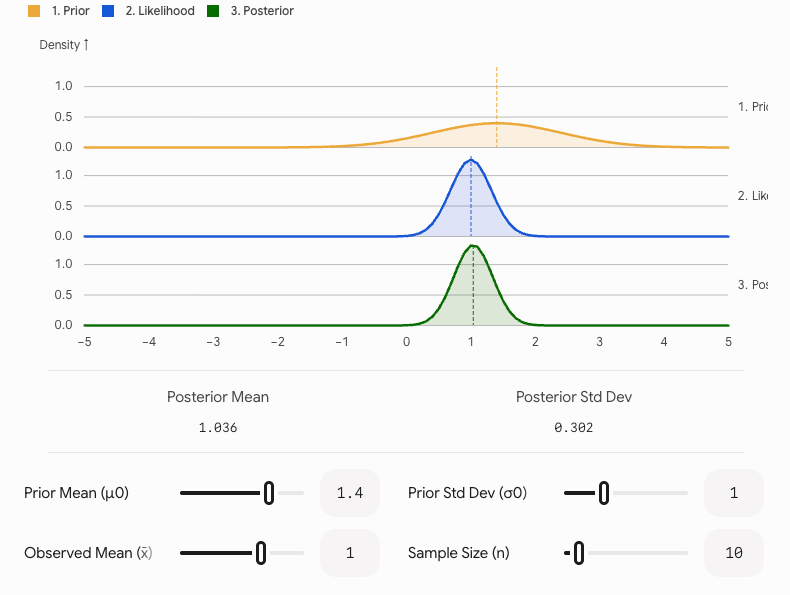
Here is the estimation visualization for a cse like observed mean as 1, prior mean as 1.4, Prior Std Dev as 1, and with a 10 samples size.
Here is the estimation visualization for a cse like observed mean as 1, prior mean as 1.4, Prior Std Dev as 1, and with a 80 samples size.
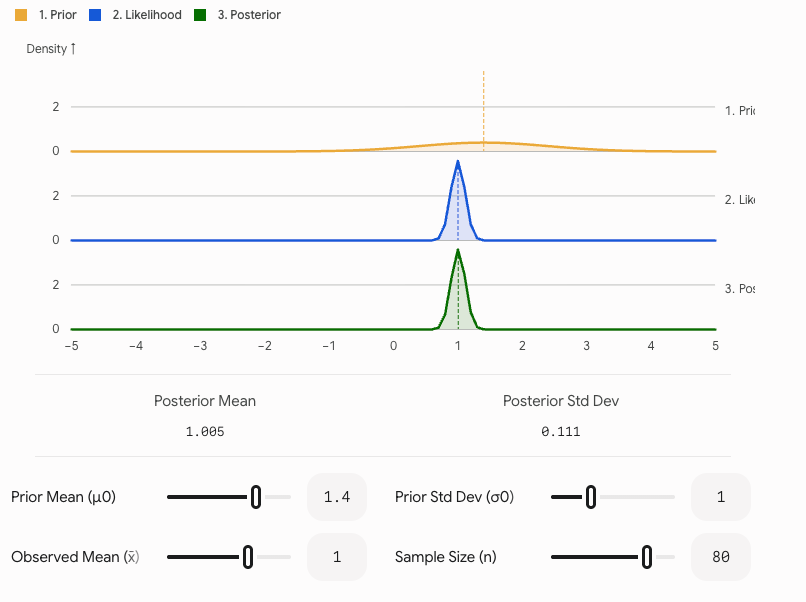
With sample numbers increase the ratio of currenction will be increased. so a circle, the camera gathering more than 50 times, so it can recognize the PRPD with a high accurrancy.
The algorithm assumes four defect categories: corona discharge, surface discharge, floating discharge, and noise (particle discharge). Each category has its own PRPD distribution, so a standard probability distribution can be used as the likelihood function for modeling, and the final detection result is obtained through Bayesian estimation.
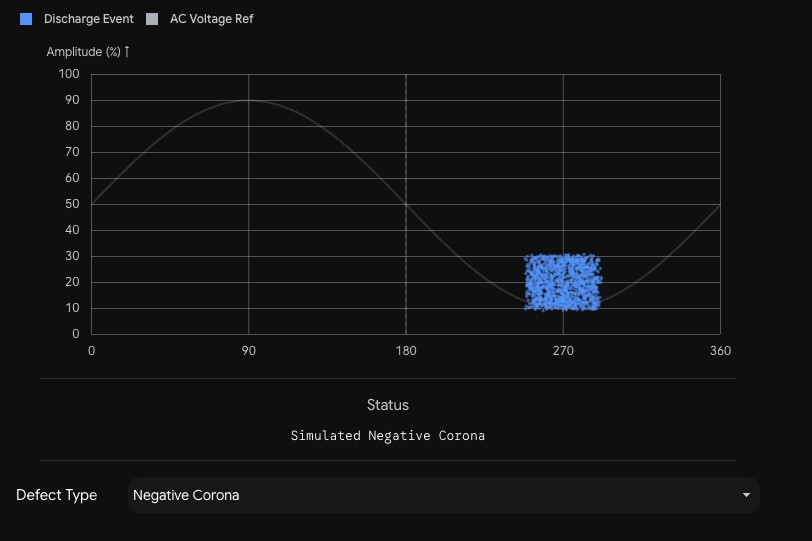
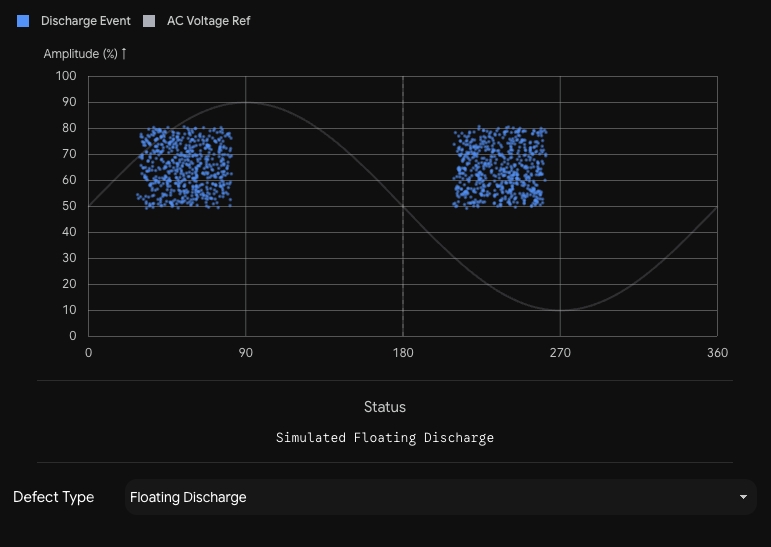
Why Positive and Negative Corona Cannot Be Separated
It should be noted that while positive and negative corona can be physically distinguished, the acoustic camera lacks a voltage polarity reference and cannot determine the absolute voltage zero-crossing. Therefore, in the practical recognition algorithm, positive and negative corona are unified into a single “corona discharge” class. This is precisely why an acoustic camera cannot differentiate between negative and positive corona. Nevertheless, even with this merging, the acoustic camera can still provide high-confidence results for the overall detection of corona-type discharges.
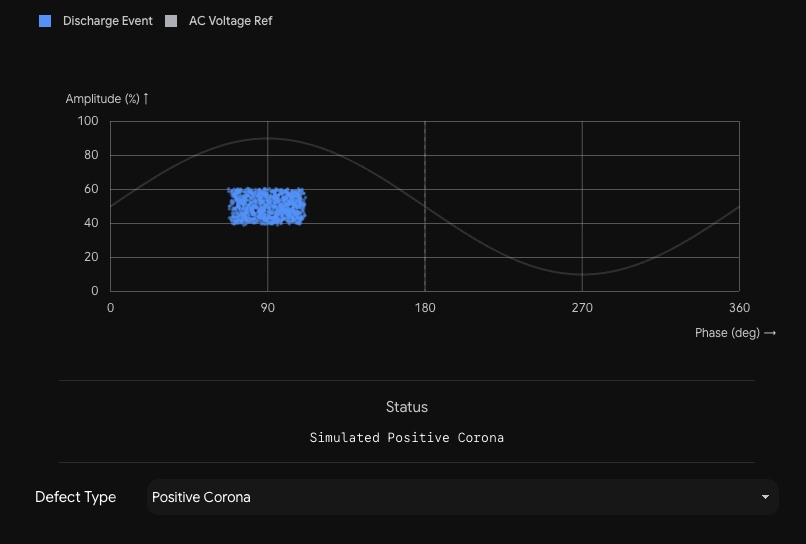
AI-Based Robust Alignment and Anomaly Identification
To further enhance system robustness in complex field environments, artificial intelligence is introduced to handle challenges such as noise interference, multi-source discharge superposition, sensor variability, and unstable phase references. The AI model can directly output the phase offset Δϕ , a confidence score, the defect category, and an indication of whether multi-source superposition is present.
Retaining the “Uncertain” State
The system retains an “uncertain” state: when the PRPD pattern is too sparse, the noise level is excessively high, the defect type is unknown, or multi-source superposition is evident, the model does not force an alignment. Instead, it returns a low confidence or rejects the judgment, thereby avoiding misclassification.
Self-Supervised Learning for Phase Restoration
During the training phase, a self-supervised learning strategy is adopted to automatically construct large-scale samples: artificial random cyclic shifts (e.g., , , ) are applied to the PRPD patterns, and the model is tasked with predicting this offset. This provides abundant training data without manual labeling and enables the model to learn to recover the true phase from perturbations.
Differentiable Phase Shift Layer
In terms of model architecture, a differentiable phase shift layer (analogous to a circular shift structure in a spatial transformer network) can be embedded, allowing the network to automatically search for the optimal phase translation during forward propagation so that the input pattern best matches the internal reference template, thereby achieving end-to-end phase alignment.
Phase-Invariant Classification
When the objective is only to identify the defect type and not to recover the absolute phase, a phase-invariant classification strategy can be employed. During data augmentation, the PRPD patterns are randomly rotated, forcing the model to learn “shape features” that are independent of absolute phase position. This yields a classifier insensitive to phase rotation, capable of accurately distinguishing defect types even without precise alignment.